
Subaru Telescope Captures M82: Unveiling a Galactic Fireworks Show
Subaru Telescope Captures M82: Unveiling a Galactic Fireworks Show
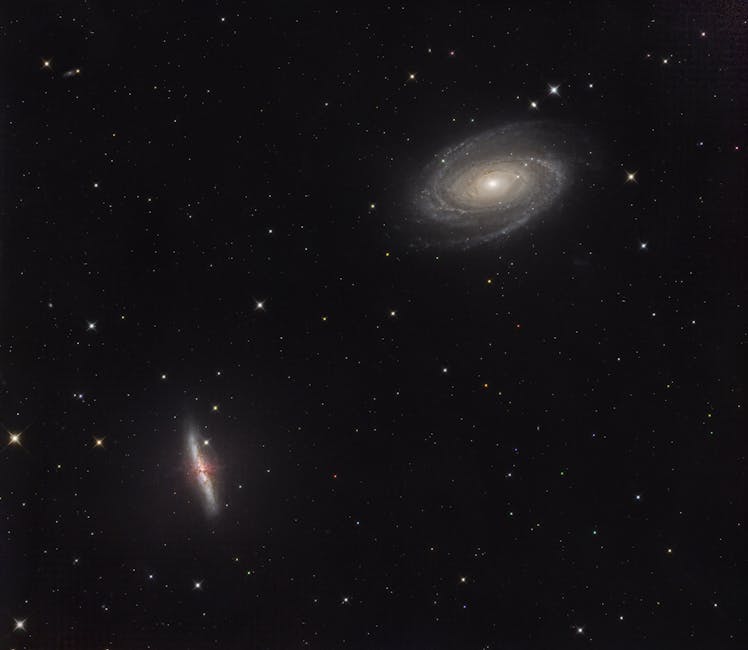
The Subaru Telescope, perched atop Maunakea in Hawaii, has recently delivered breathtaking new images of Messier 82 (M82), commonly known as the Cigar Galaxy. This irregular starburst galaxy, located approximately 12 million light-years away in the constellation Ursa Major, offers an unparalleled view into the dramatic processes of rapid star formation and galactic evolution.
The latest observations provide astronomers with unprecedented detail, shedding new light on the intense stellar birth rates and powerful galactic winds that define this dynamic celestial object.
Background: The Energetic Heart of M82 and Subaru’s Vision
M82 stands as a quintessential example of an irregular starburst galaxy, a type of galaxy characterized by an exceptionally high rate of star formation, far exceeding that of typical galaxies like our Milky Way. Discovered by Johann Elert Bode in 1774 and later cataloged by Charles Messier in 1781, M82 has long captivated astronomers due to its unique appearance and energetic activity.
Its distinctive elongated shape and bright core led to its popular moniker, the Cigar Galaxy. Positioned in the constellation Ursa Major, M82 forms a prominent pair with the larger, spiral galaxy M81, with which it is gravitationally interacting. This close encounter with M81 is widely believed to be the primary catalyst for M82's frantic star-forming activity.
The Starburst Phenomenon
A starburst galaxy is essentially a stellar factory operating in overdrive. These galaxies experience bursts of star formation that consume their gas reservoirs at an accelerated pace. In M82, stars are forming at a rate ten times faster than in the entire Milky Way, concentrated within a relatively small central region. This intense stellar nursery leads to a high number of massive, short-lived stars.
The rapid birth and death of these massive stars result in frequent supernova explosions. These supernovae, along with the strong stellar winds from young, hot stars, drive powerful outflows of gas and dust known as galactic winds. These winds can be observed as plumes extending perpendicular to the galaxy’s disk, carrying enriched material into the intergalactic medium and profoundly influencing the galaxy’s future evolution.
Understanding starburst galaxies like M82 is crucial for comprehending galaxy evolution across cosmic time. Such energetic phases were far more common in the early universe, making M82 a nearby laboratory for studying processes that shaped the first galaxies.
The Subaru Telescope: A Giant Eye on Maunakea
The Subaru Telescope, operated by the National Astronomical Observatory of Japan (NAOJ), is an 8.2-meter optical-infrared telescope located near the summit of Maunakea, Hawaii, at an elevation of 4,200 meters (13,800 feet). Maunakea’s high altitude, dry atmosphere, and minimal light pollution provide some of the best astronomical observing conditions on Earth.
Commissioned in 1999, Subaru is renowned for its unique monolithic primary mirror, which is exceptionally thin for its size, and its wide field of view. This combination allows it to capture vast swathes of the sky with remarkable clarity and depth. The telescope is equipped with a suite of cutting-edge instruments, enabling observations across a broad range of wavelengths and for diverse scientific programs.
Key instruments include the Hyper Suprime-Cam (HSC), a wide-field imager capable of surveying large areas of the sky with unprecedented detail, and various spectrographs and infrared cameras that probe the composition, motion, and temperature of distant celestial objects. Subaru’s advanced adaptive optics system further refines its vision, compensating for atmospheric distortions to produce sharper images.
The telescope’s primary mission includes studying the formation and evolution of galaxies, searching for exoplanets, and exploring the large-scale structure of the universe. Its capabilities make it particularly well-suited for capturing extended, complex objects like M82, where both fine detail and broad context are essential.
Key Developments: Unraveling M82’s Starburst Secrets
The recent observations by the Subaru Telescope have provided a fresh perspective on M82, leveraging its unique wide-field imaging capabilities and high sensitivity. While specific instruments used for the latest public release were not always detailed, the general capabilities of instruments like Hyper Suprime-Cam (HSC) are well-suited for capturing the full extent of a galaxy like M82 with remarkable clarity.
These new images highlight several critical features of M82 with enhanced precision, offering astronomers new data points to refine their models of starburst activity and galactic dynamics.
Detailed Views of Star-Forming Regions
The Subaru data reveals intricate details within M82’s central starburst region, an area only about 500 parsecs (1,600 light-years) across. Within this compact zone, the birth rate of stars is extraordinarily high. The images delineate individual star clusters and vast nebulae, glowing with the light of newly formed massive stars. These regions are often obscured by thick lanes of dust, but Subaru’s deep exposures and multi-wavelength filters can penetrate some of this obscuration.
Astronomers can now better map the distribution of these star-forming nurseries, identifying hotspots where gas clouds are collapsing most rapidly. This granular detail helps in understanding the triggering mechanisms for star formation and how stellar populations evolve within such extreme environments.
Probing the Galactic Wind
One of M82’s most striking features is its powerful galactic wind, a colossal outflow of gas and dust driven by the collective energy of supernovae and stellar winds from millions of young stars. The Subaru images provide clearer views of the extent and structure of these bipolar outflows, which extend thousands of light-years perpendicular to the galaxy’s disk.
These observations allow scientists to study the morphology of the wind, identifying filaments and bubbles of gas that are being expelled at high velocities. Such outflows are crucial for understanding how galaxies self-regulate their star formation, as they can eject significant amounts of gas and heavy elements, potentially halting future star formation and enriching the intergalactic medium.
The Influence of M81
M82’s starburst activity is a direct consequence of its gravitational interaction with its larger neighbor, M81. Over hundreds of millions of years, M81 has made several close passes to M82, triggering gravitational tides that compress M82’s gas clouds. This compression ignites rapid star formation. The new Subaru observations contribute to a more complete picture of this interaction.
By observing M82 and its immediate surroundings with high sensitivity, astronomers can look for subtle signs of tidal streams or disrupted gas clouds that trace the history of these galactic encounters. Understanding the precise timing and impact of these interactions is key to modeling how external forces can drive such dramatic internal changes within a galaxy.
Complementing Other Observatories
The Subaru Telescope’s observations of M82 do not exist in isolation but rather complement a rich tapestry of data from other world-class observatories. The Hubble Space Telescope has provided iconic visible-light images, revealing fine details of dust lanes and star clusters. X-ray telescopes like Chandra have mapped the hot gas in the galactic wind, while infrared observatories such as Spitzer have peered through the dust to reveal hidden star formation.
Radio telescopes, like the Very Large Array (VLA), have traced the distribution of cold gas and supernova remnants. Subaru’s wide-field optical and near-infrared capabilities bridge gaps in these multi-wavelength studies, offering a comprehensive view that combines broad context with significant detail, particularly useful for studying the extended features of the galactic wind and the interplay between star formation and its environment.
Impact: Reshaping Our Galactic Understanding
The detailed insights provided by the Subaru Telescope's observations of M82 have profound implications across several branches of astrophysics, influencing how scientists perceive galaxy evolution, star formation processes, and the dynamics of galactic interactions. The impact extends from theoretical modeling to public engagement, solidifying M82's role as a vital astrophysical laboratory.
Advancing Galaxy Evolution Theories
M82 serves as a critical testbed for theories of galaxy evolution, particularly those involving starburst phases. The Subaru data helps validate and refine models that describe how gravitational interactions between galaxies trigger intense bursts of star formation. By meticulously mapping the distribution of young stars, gas, and dust, astronomers can better understand the efficiency of star formation in dense environments and the conditions under which it can be sustained or quenched.
These observations contribute directly to our understanding of the early universe, where starburst galaxies were far more prevalent. Lessons learned from M82 can be extrapolated to interpret observations of distant, high-redshift galaxies, offering clues about how the first massive galaxies assembled and evolved.
Insights into Stellar Feedback Mechanisms
The powerful galactic wind emanating from M82 is a prime example of stellar feedback, where the energy and material from star formation significantly impact the surrounding interstellar and intergalactic medium. Subaru’s detailed views of these outflows are crucial for understanding how galaxies regulate their growth.
Scientists can now better quantify the amount of gas and heavy elements expelled from the galaxy, which has implications for the chemical enrichment of the intergalactic medium and the availability of fuel for future star formation within M82 itself. This feedback mechanism is a key ingredient in cosmological simulations of galaxy formation, and M82 provides real-world data to constrain these complex models.
Technological Prowess and Future Instrumentation
The successful capture of such detailed images of M82 underscores the remarkable capabilities of the Subaru Telescope and its instrumentation. It showcases the effectiveness of its wide-field imager and potentially its adaptive optics in resolving fine structures even in a relatively nearby, complex object. This achievement not only demonstrates current technological prowess but also informs the design and development of future astronomical instruments and telescopes.
The data processing techniques required to extract meaningful scientific information from such deep and wide observations also push the boundaries of computational astrophysics, leading to advancements that benefit the entire scientific community.
Inspiring Public Engagement and Education
Beyond its scientific merits, the stunning imagery of M82 captured by Subaru has a significant impact on public engagement with science. These visually arresting pictures serve as powerful tools for communicating the wonders of the universe to a broad audience, inspiring interest in astronomy, physics, and STEM fields.
Educational institutions and outreach programs frequently utilize such images to explain complex astrophysical phenomena in an accessible manner, fostering a greater appreciation for scientific discovery and the ongoing exploration of the cosmos.
What Next: The Future of M82 Research
The Subaru Telescope's latest contribution to the study of M82 marks another significant milestone, yet it also opens new avenues for future research. The complexity and dynamism of this starburst galaxy ensure it will remain a focal point for astronomers, with ongoing and planned observations leveraging new technologies and methodologies.
Multi-Wavelength Follow-Up and Data Integration
The immediate next steps involve comprehensive multi-wavelength follow-up observations. While Subaru excels in optical and near-infrared, integrating this data with observations from other parts of the electromagnetic spectrum is crucial. For instance, combining Subaru’s images with data from X-ray observatories like NASA’s Chandra X-ray Observatory will provide a more complete picture of the hot gas in the galactic wind, revealing its temperature, density, and dynamics.
Similarly, linking with radio observations from facilities like the Atacama Large Millimeter/submillimeter Array (ALMA) will trace the distribution of cold molecular gas, the raw material for star formation, with unprecedented resolution. This holistic approach will allow astronomers to build more robust, multi-phase models of M82’s starburst activity and its interaction with the surrounding medium.
Spectroscopic Surveys and Kinematic Studies
Future research will heavily rely on spectroscopic observations to unravel the kinematics and chemical composition of M82. High-resolution spectrographs can measure the velocities of gas and stars within the galaxy, providing a 3D view of its internal motions and the speed of the galactic wind. This is vital for understanding how material is being expelled and recycled within the galaxy.
Spectroscopy also allows for detailed chemical abundance studies, revealing the “metallicity” (abundance of elements heavier than hydrogen and helium) of different regions. This can shed light on the star formation history of M82 and how efficiently heavy elements are produced and dispersed by supernovae.
The Role of Next-Generation Telescopes
The advent of next-generation observatories promises even deeper insights into M82. The James Webb Space Telescope (JWST), with its unparalleled infrared sensitivity, will be instrumental in peering through the thick dust lanes that obscure much of the starburst activity. JWST can resolve individual young star clusters and probe the earliest stages of star formation within M82, offering details currently inaccessible to ground-based optical telescopes.
Looking further ahead, future extremely large ground-based telescopes, such as the European Extremely Large Telescope (ELT), the Thirty Meter Telescope (TMT), and the Giant Magellan Telescope (GMT), will offer even greater light-gathering power and spatial resolution. These behemoths will be capable of resolving individual stars and star-forming regions in M82 with exquisite detail, potentially even detecting exoplanets within its starburst environment, though this remains a highly challenging prospect.
Long-Term Monitoring and Transient Events
M82 is a dynamically evolving galaxy. Long-term monitoring campaigns will continue to track changes in its star formation rate, the evolution of its galactic wind, and the occurrence of transient events like supernovae. Given its high star formation rate, M82 is a frequent host of supernovae, and detecting these events can provide valuable data on the types of massive stars being formed and their ultimate fates.
Continued observation will also help refine models of the M81-M82 interaction, potentially revealing subtle changes in M82’s structure or gas distribution that indicate the ongoing gravitational dance between the two galaxies.
Ultimately, M82 will remain a cornerstone for understanding the extreme physics of starbursts, the fundamental processes of galaxy evolution, and the interplay between internal galactic activity and external gravitational forces. Each new observation, like those from the Subaru Telescope, adds another crucial piece to this complex cosmic puzzle.
