
Sea Turtles Offer Direct Cyclone Observations
A groundbreaking research initiative is leveraging instrumented sea turtles to gather direct, in-situ oceanographic data during tropical cyclones. This novel approach provides unprecedented insights into the conditions within these powerful storms, offering a new dimension to hurricane forecasting and climate science.
Background: A New Frontier in Ocean Observation
For decades, understanding the internal dynamics of tropical cyclones has relied primarily on remote sensing and sporadic direct measurements. Satellites provide broad-scale imagery and sea surface temperature data, but their penetration into the ocean's subsurface is limited. Oceanographic buoys offer point-source data but are often sparse and vulnerable to destruction by extreme weather. Aircraft equipped with dropsondes brave the storm's periphery, releasing instruments that fall through the atmosphere, providing atmospheric profiles but offering only fleeting glimpses of the underlying ocean's response.
The ocean plays a critical, yet often under-observed, role in the intensification and weakening of tropical cyclones. Warm ocean waters fuel these storms, and the mixing of cooler subsurface waters can moderate their strength. Obtaining continuous, direct measurements within the upper ocean layers during a storm's passage has remained a formidable challenge. The immense power of hurricanes makes traditional instrument deployment and retrieval hazardous and often impossible, leading to significant gaps in our observational network.
The concept of using marine animals as 'bio-loggers' is not entirely new. Researchers have long attached sensors to seals, whales, and other large marine fauna to study their behavior and the ocean environments they inhabit. These pioneering efforts demonstrated the potential of leveraging animal movements to gather data from remote or difficult-to-access regions. However, applying this methodology specifically to the extreme conditions of tropical cyclones presented unique engineering and biological considerations.
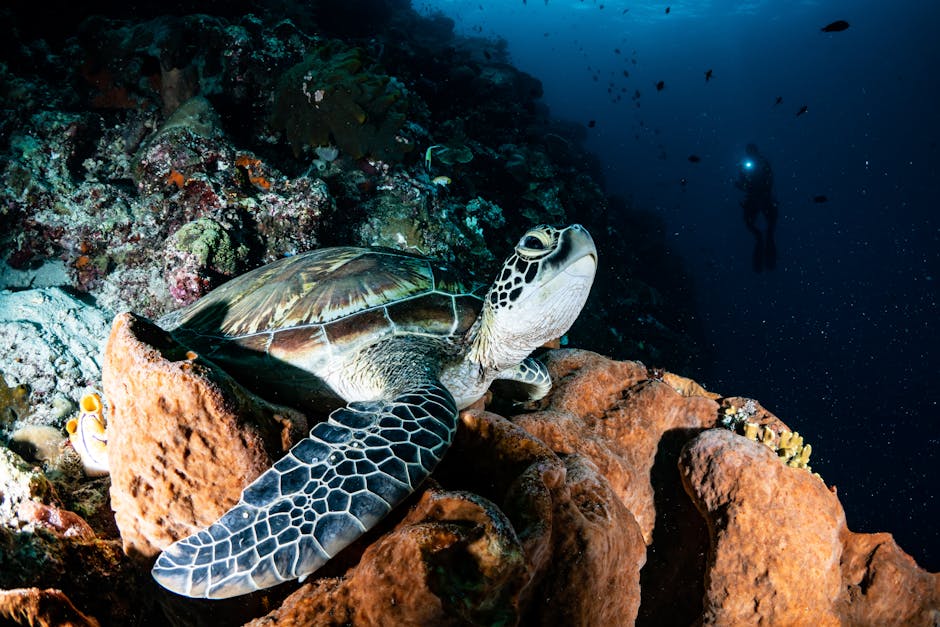
Sea turtles emerged as ideal candidates for this specialized task. Species like loggerheads (Caretta caretta) and green sea turtles (Chelonia mydas) inhabit vast expanses of tropical and subtropical oceans, precisely where hurricanes originate and track. Their extensive migratory patterns often place them directly in the path of developing storms. Furthermore, their robust physiology allows them to withstand turbulent conditions, and their deep-diving capabilities enable them to sample the water column through significant depths, providing crucial vertical profiles of ocean temperature and salinity.
The technological leap required to implement this vision involved significant advancements in miniaturized sensor technology. Researchers developed compact, low-power satellite transmitters, often utilizing the Argos system for global data relay, integrated with various oceanographic sensors. These 'turtle tags' are designed to be minimally invasive, affixed to the turtle's carapace using specialized epoxy or adhesive, ensuring the animal's natural behavior is not impeded. Early prototypes focused on basic location tracking and surface temperature, but successive generations of tags have incorporated sophisticated sensors for depth, water temperature at various depths, and even salinity.
Initial pilot studies, dating back to the early 2000s, explored the feasibility of tracking sea turtles through various oceanographic features. These foundational projects, often spearheaded by institutions like the National Oceanic and Atmospheric Administration (NOAA) and several leading marine research universities, demonstrated the reliability of the tagging technology and the potential for long-term data acquisition. The transition to specifically targeting tropical cyclone observation began to solidify as researchers recognized the unique intersection of turtle habitats and storm tracks.
The timeline accelerated in the last decade, with increased funding and interdisciplinary collaboration. Oceanographers, marine biologists, and atmospheric scientists began working in concert to refine the tagging protocols, improve sensor accuracy, and develop sophisticated data processing algorithms. This collaborative effort has been crucial in transforming a novel idea into a viable, impactful scientific tool, paving the way for the direct observation of the ocean's response to some of Earth's most destructive weather phenomena.
Key Developments: Unprecedented Data from Within the Storm
Recent years have marked a significant acceleration in the deployment and data acquisition from instrumented sea turtles, particularly during active tropical cyclone seasons. The 2017 Atlantic hurricane season, with its succession of powerful storms like Hurricanes Irma and Maria, provided early, albeit limited, opportunities to test the system under extreme conditions. Subsequent seasons have seen more deliberate efforts, with turtles equipped with advanced tags encountering and surviving direct passages of major hurricanes, including Category 3 and 4 storms.
One of the most significant developments has been the successful collection of high-resolution, vertical profiles of ocean temperature and salinity from within the storm's vortex. As a tagged turtle dives, its sensors record these parameters at varying depths, providing a continuous snapshot of the water column. This data reveals critical changes in the ocean's mixed layer depth – the upper layer of the ocean that is directly influenced by atmospheric conditions. Prior to this, such detailed vertical data from the eye or eyewall region of a hurricane was virtually impossible to obtain.
For instance, observations during the passage of a recent Category 4 hurricane revealed rapid and dramatic cooling of the sea surface temperature, not just at the immediate surface, but extending several tens of meters deep. This cooling, driven by intense wind-driven mixing and upwelling of cooler subsurface waters, is a crucial feedback mechanism that can influence a hurricane's intensity. The turtle data provided direct evidence of this phenomenon with unprecedented spatial and temporal detail, showing how quickly the ocean responds to the storm's immense energy.
Technological refinements in the 'turtle tags' have been pivotal. Modern tags boast significantly improved battery life, allowing for data collection over longer periods, sometimes exceeding a year. The data resolution has also increased, enabling more frequent sampling intervals and finer vertical profiles. While true real-time streaming from within a hurricane remains challenging due to signal attenuation, advancements in data compression and transmission protocols have allowed for quicker data retrieval once the turtle surfaces in calmer waters, or when the storm passes.
Furthermore, efforts have focused on the seamless integration of this unique bio-logging data with existing oceanographic and atmospheric models. Researchers are now feeding the turtle-derived temperature and salinity profiles directly into numerical weather prediction models and ocean circulation models. This integration helps to 'ground truth' satellite observations and improve the initial conditions for hurricane intensity forecasts, which are notoriously difficult to predict accurately. The data helps refine our understanding of ocean heat content, a key determinant of hurricane strength.
Unexpected insights have also emerged. For example, some turtle tracks have revealed complex current patterns and eddy formations induced by the passage of a hurricane, which were not fully captured by coarser resolution models or satellite altimetry. These localized oceanographic responses can have long-lasting impacts on marine ecosystems and energy distribution within the ocean. The ability of turtles to navigate through these dynamic environments provides a unique mobile platform for observing such phenomena.
The scope of the project is also expanding. While initial efforts concentrated on species common in the Atlantic and Caribbean, there is growing interest in deploying similar instrumented turtles in the Pacific and Indian Oceans, regions also prone to powerful tropical cyclones. Researchers are also exploring the potential of tagging different species of sea turtles that might exhibit different diving behaviors or inhabit distinct oceanographic zones, further diversifying the data collection capabilities.
Impact: Enhancing Safety and Scientific Understanding
The direct oceanographic observations provided by instrumented sea turtles are poised to have a profound impact across several critical domains, from enhancing immediate hurricane preparedness to deepening our fundamental understanding of climate dynamics.
Perhaps the most immediate and tangible benefit lies in hurricane forecasting. Accurately predicting the intensity of tropical cyclones remains one of the greatest challenges for meteorologists. While track forecasts have improved significantly over the past decades, intensity predictions still lag. The turtle data, by providing real-time, in-situ measurements of ocean temperature, salinity, and mixed layer depth directly within a storm's path, offers crucial insights into the ocean's heat content and its capacity to fuel a hurricane. This information helps forecasters refine their models, leading to more accurate intensity predictions and longer lead times for warnings.
For coastal communities, more precise intensity forecasts translate directly into better preparedness and potentially saved lives and property. Knowing with greater certainty whether a storm is likely to strengthen into a major hurricane or weaken before landfall allows emergency managers to make more informed decisions regarding evacuations, resource allocation, and protective measures. This can mitigate economic losses, reduce infrastructure damage, and streamline post-storm recovery efforts.
Beyond immediate forecasting, the data contributes significantly to climate science. Tropical cyclones are critical mechanisms for transferring heat from the ocean to the atmosphere, playing a vital role in global energy budgets. The detailed oceanographic profiles collected by turtles help scientists better quantify these heat exchanges and understand the complex feedback loops between the ocean and the atmosphere during extreme weather events. This improved understanding is essential for developing more robust climate models and predicting how tropical cyclone activity might change in a warming world.
The project also yields invaluable insights for marine biology and conservation efforts. Observing how sea turtles behave and respond to the passage of a hurricane provides unique data on their resilience and survival strategies during extreme events. It sheds light on how these long-lived species navigate turbulent waters, seek refuge, or adapt their diving patterns. This information can inform conservation strategies, particularly in the context of increasing storm frequency or intensity linked to climate change, helping protect these endangered and threatened species.
The shipping and maritime industries also stand to benefit. Improved hurricane forecasts allow for safer routing of vessels, minimizing risks to crews and cargo. This can reduce operational costs associated with rerouting or sheltering ships and enhance overall maritime safety in cyclone-prone regions. Furthermore, the data on ocean currents and mixing can contribute to broader oceanographic charts and models used by various marine operations.
Economically, the implications are substantial. More accurate forecasts can lead to reduced insurance losses, as communities can implement more targeted and effective mitigation strategies. Industries reliant on coastal infrastructure, such as fisheries, tourism, and energy, can better plan for and recover from storm impacts. The investment in this innovative research, therefore, carries the potential for significant societal and economic returns by enhancing resilience against one of nature's most destructive forces.
What Next: Expanding Capabilities and Global Reach
The success of using instrumented sea turtles for tropical cyclone observation marks a new frontier in oceanography, and the path ahead is rich with potential advancements and expanded applications. Researchers are already outlining ambitious milestones for the coming years, aiming to refine the technology, broaden its reach, and deepen its scientific impact.
A primary focus for future development is the continued miniaturization and enhancement of the 'turtle tags.' The goal is to create even smaller, lighter, and more hydrodynamically efficient devices that impose even less burden on the turtles. Engineers are exploring advanced materials for increased durability and energy harvesting technologies, such as solar or kinetic power, to extend battery life indefinitely. The integration of advanced on-board processing capabilities, potentially leveraging artificial intelligence, could allow tags to make smart decisions about when and what data to transmit, optimizing bandwidth and power usage.
Geographic expansion is another key objective. While current efforts have yielded significant data from the Atlantic and Caribbean, plans are underway to establish robust tagging programs in other major tropical cyclone basins, including the Western Pacific (typhoons) and the Indian Ocean (cyclones). This global approach will provide a more comprehensive understanding of storm dynamics across different oceanographic regimes and improve global forecasting capabilities.
The future also envisions greater synergy between instrumented sea turtles and other autonomous oceanographic platforms. Imagine a coordinated network where turtle data complements observations from ocean gliders, autonomous underwater vehicles (AUVs), and profiling floats. Gliders can be directed to areas of interest identified by turtle movements, while turtles can provide unique data points in regions too hazardous for traditional platforms. This multi-platform approach will create an unprecedented, dynamic picture of the ocean's response to extreme weather.
Achieving closer to real-time data transmission remains a critical, albeit challenging, goal. While current systems provide data post-storm or after surfacing, researchers are exploring high-bandwidth satellite communication solutions that could potentially push data more rapidly, even from within the storm's periphery. This would significantly enhance the operational utility of the data for immediate forecasting updates.
Ultimately, the vision is to establish a long-term, sustainable global network of instrumented marine animals contributing to ocean observation. This would involve international collaboration, standardized tagging protocols, and shared data infrastructure. Such a network would not only provide continuous data streams for tropical cyclone monitoring but also contribute to broader ocean health assessments, climate monitoring, and marine ecosystem research.
Scientifically, the enhanced data stream will enable researchers to address new, complex questions. For instance, how do different oceanographic features, such as eddies or fronts, influence a hurricane's interaction with the ocean? Can turtle data help predict rapid intensification events with greater accuracy? How does the accumulated ocean heat content over an entire season affect the overall intensity and frequency of storms? These are questions that require the kind of continuous, in-situ data that instrumented turtles can uniquely provide.
Finally, the policy implications of this research are substantial. The improved forecasting capabilities can directly inform national and international disaster preparedness strategies, resource allocation for humanitarian aid, and infrastructure planning in vulnerable coastal regions. Furthermore, the enhanced understanding of ocean-atmosphere coupling derived from turtle data will be crucial for informing climate change adaptation and mitigation policies, providing a clearer picture of future storm risks and the role of the ocean in a changing climate.
